
Coaching Is Everywhere—So Why Isn’t Performance Improving?


Coaching has become the universal answer to performance problems.
Missed targets? Coach more.
Low engagement? Coach better.
Uneven development? Add coaching touchpoints.
On paper, this makes sense. Research consistently shows coaching is linked to improved performance, well-being, and goal attainment (Theeboom et al., 2013; Cannon et al., 2023). And yet, as we explored in Why Coaching Efforts Stall—and What Actually Moves Performance, many organizations are stuck in a frustrating reality: coaching is happening, but results are inconsistent.
So what’s going wrong?
The Gap Between Coaching Intent and Coaching Impact
Most organizations don’t lack commitment to coaching. Leaders care deeply about developing their people. The issue isn’t motivation—it’s continuity.
Coaching often lives in isolated moments: a quarterly check-in, a ride-along, a post-project debrief. These moments can be high quality, but they’re rarely connected to what happens next. Without reinforcement, coaching becomes episodic instead of developmental.
Performance change doesn’t happen in the conversation, it happens in the days and weeks after. That’s where many systems fall apart.
Employees need support between coaching rhythms, including:
- Reminders of what they committed to change
- Reflection prompts to reinforce learning
- Opportunities to practice new behaviors
- Clear accountability for follow-through
When these elements are missing, coaching becomes disconnected from real work. Gallup’s long-standing research reinforces this point, showing that unclear expectations and insufficient follow-up undermine motivation and performance (Wigert & Harter, 2017).
Coaching Is a System, Not an Event
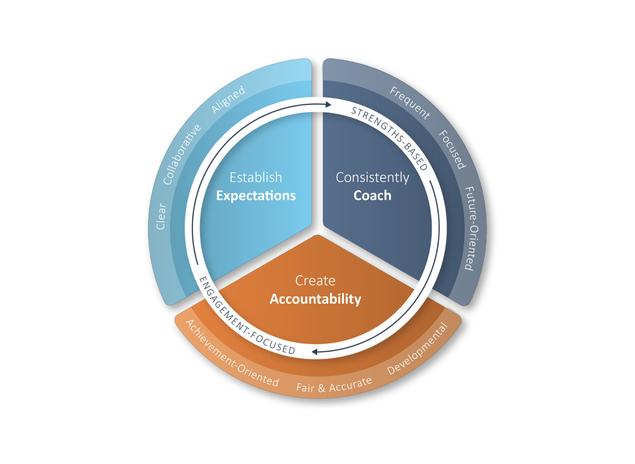
The core idea from the article is simple but powerful: coaching only works when it’s operationalized as a system.
A system creates consistency. It ensures that what happens in a coaching conversation carries forward into behavior change. Without that system, even skilled coaches struggle to drive sustained impact.
This explains why organizations often default to “more coaching” when results lag. More check-ins. More templates. More training. But volume doesn’t fix fragmentation.
What actually matters is whether coaching creates a repeatable rhythm:
- Observe real work
- Deliver specific feedback
- Agree on concrete actions
- Reinforce through practice
- Measure what changes over time
Without all five, coaching stalls.
Why Performance Still Feels Elusive
When coaching lacks continuity, three things happen:
- Feedback doesn’t translate into action
- Coaching quality varies wildly across teams
- Employees receive support only when something goes wrong
Research cited in the article (Lam et al., 2002) shows that inconsistent or primarily negative coaching damages job satisfaction and commitment for months. This isn’t just a performance issue—it’s a culture issue.
The takeaway from Week 1 is clear: coaching is not failing because people don’t believe in it. It’s failing because it’s treated as a series of conversations instead of a performance system.
How Unboxed Can Help
At Unboxed, we help organizations move from coaching intent to coaching impact.
We design coaching systems that:
- Create consistent rhythms between conversations
- Reinforce commitments with prompts, practice, and reflection
- Make coaching observable, measurable, and repeatable
Our Skill Building Platform supports coaching continuity by embedding feedback, practice, and follow-through into daily workflows—so performance improvement doesn’t depend on memory or motivation alone.
Because coaching doesn’t need to be louder.
It needs to be connected.